
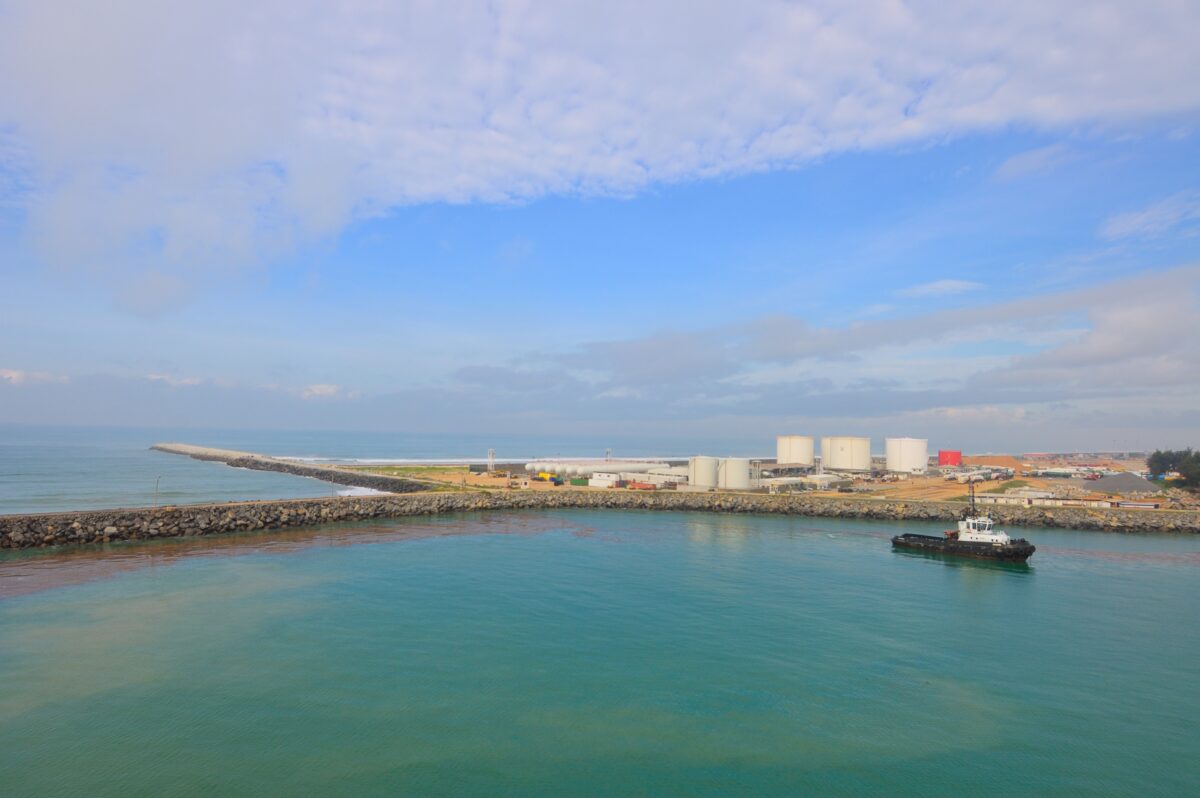
Port of Cotonou Expansion
Adaptation Need
The Port of Cotonou faces climate-related risks that could impact its infrastructure, operations, and surrounding areas. For instance, the economic impact of rising temperatures—particularly the increase in days exceeding 35ºC due to climate change—is expected to escalate significantly. As temperatures rise, productivity is expected to decrease by 10% on days exceeding 35ºC (with relative humidity often above 80%). By 2090, under a high-emissions scenario (RCP8.5), the economic impact of this heat stress could escalate from €20,000 annually to more than €2.2 million, driven by an increase in dangerously hot days. While the Port Master Plan includes measures to protect against climate risks, it lacks a detailed analysis and quantification of their effectiveness. There are opportunities to mobilize climate finance to address projected climate risks and enhance the port’s resilience.
GCA’s Added Value
GCA provided a high-granularity climate risks assessment, allowing for a detailed quantification of direct impacts of climate hazards on the assets and operations (damages and revenue losses due to operations disruptions). GCA proposed a prioritized set of economically viable adaptation measures mitigating the identified risks. GCA technical analysis was delivered as an investment rationale, highlighting and quantifying costs and clear benefits over time of investing in such adaptation measures. The financing rationale provided by GCA successfully supported AfDB to request adaptation finance for these adaptation and resilience interventions.


Project goals
Mainstreaming Adaptation and Resilience
To address climate risks, GCA has proposed a range of adaptation measures in particular measures which reduce the exposure to heat risk. GCA’s financial model shows that the adaptation measures could prevent up to €400 million in lost revenue over the first 30 years—essentially matching the project’s total investment cost. After the first 30 years, the benefits are expected to increase further, reaching savings estimated to be between 26-40 Million Euros annually by 2100. Further to the financial benefits, there are considerable socio-economic gains in terms of job security, the livelihood of the local fishery community, and the position of females. GCA outputs have been successfully used to mobilize $ 18 million in climate finance from Canada-African Development Bank Climate Facility (CACF) to finance additional resilience components.
Expected Outcomes
- Increase the volume of cargo handled annually from 10.1 to 13.5 metric tons.
- Directly foster import/export of agricultural based inputs and farm produce through the port
- Contribute to the GDP growth of Benin where revenues from the port already account for 45% of the economy
Timeline
GCA Support Status
Technical Assistance Preparation
GCA Support Implementation
July, 2023
GCA Support Completion
Monitoring
Finance
Project Investment Value
Total Investment Value
IFI Investment Value
$108.62M
Other Investment Value
N/A
IFI partners
Contacts
General media inquiries
info@gca.orgRequest for information
infrastructure@gca.org