
A Decade After Paris: Where are we with the Global Goal Adaptation?
Ten years after the Paris Agreement, the global adaptation agenda finally resembles a structured system rather than a loose set of aspirations. But it took far longer than expected to reach this point, and many of the gaps that slowed progress remain visible today, especially around finance and implementation.
When Parties established the Global Goal on Adaptation in 2015, the ambition was clear enhancing adaptive capacity, strengthening resilience, and reducing vulnerability at a global scale. What wasn’t clear was the operational pathway. The goal lacked definition, metrics, and a shared understanding of what counted as progress. In practice, most governments continued to treat adaptation as a national planning exercise rather than a coordinated global effort.
Momentum only picked up years later with the launch of the Glasgow–Sharm el-Sheikh work programme at COP 26 in Glasgow. COP27 went on to develop a framework, and COP28 in Dubai adopted that framework under the UAE Consensus, formally embedding adaptation into a global architecture. With water management, food security, health, resilient infrastructure, ecosystem conservation, poverty alleviation and the preservation of cultural heritage as core pillars of climate adaptation.
Following which a two-year process was initiated to identify indicators and develop an approach that could make adaptation progress measurable. Technical experts convened to support the technical work under the United Arab Emirates–Belém work programme which finally adopted the 59 global indicators to track adaptation progress across key sectors listed above and including indicators for includes means of implementation (finance, technology transfer, capacity building) which has been quite controversial. With links to the Modalities, procedures and guidelines for the transparency framework for action and support.
The indicators serve as the first structured, system-wide framework for tracking adaptation across countries and sectors. They’re a provisional set, meant to establish comparability and basic consistency, with a formal review planned after the second Global Stocktake in 2029. The specific timing for that review is still open.
The decision also initiates the Belém–Addis Vision on Adaptation, a two-year process where countries align their adaptation policies, drawing on earlier lessons and new technical inputs. The goal is to create solid guidance for how the Belém Adaptation Indicators should actually be used in practice. With the subsidiary bodies undertaking technical work on improving metadata and methodologies for the Belém Adaptation Indicators by 2027 at CMA 9.It’s also equally important to look at this list of indicators with the overall UNFCCC architecture for adaptation for instance the transparency framework.
Throughout all of this, one issue continues to shape the adaptation negotiations: means of implementation. In nearly every major discussion, finance for adaptation has been the key point. The global stocktake underscored the urgency behind this It made clear that if the world overshoots 1.5 degrees, adaptation costs rise sharply.
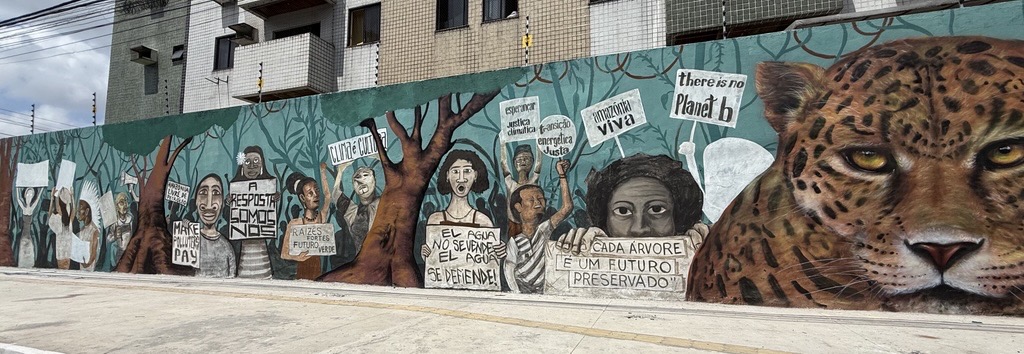
Streets of Belém
The New Collective Quantified Goal agreed in Baku at COP 29 reflects some of these concerns. It notes the gap between climate finance flows and needs, particularly for adaptation in developing country Parties. It also acknowledges the fiscal constraints they face and the increasing costs of adapting to the adverse effects of climate change. In this context, it recognizes the need for public and grant-based resources and highly concessional finance, especially for adaptation and for responding to loss and damage in developing countries. It references the need to balance mitigation and adaptation and to enhance access to finance.
But it stops short of what many developing countries had asked for. There is no dedicated sub-goal for adaptation finance. COP30 attempted to respond by announcing a commitment to triple adaptation finance by 2035, with an emphasis on support for developing countries. It signals recognition of the widening adaptation gap, but the commitment lacks clarity on scale, sources, burden sharing, and timelines. Without these details, the headline is unlikely that we bridge the gap in adaption finance. The decision reaffirms the 2021 Glasgow Climate Pact commitment to double adaptation finance by 2025, but the language today is noticeably weaker. Where Glasgow used firmer wording, this new decision leans on phrases like “urges” and “calls for efforts,” making the tripling target sound more like encouragement than obligation.
Tripling sounds bold at first glance, but even that would fall short of the scale of the adaptation challenge. The 2025 UNEP Adaptation Gap Report projects that developing countries could face an adaptation finance gap of $ 284 to $ 339 billion per year by 2035. Further more the Resilient Economies Index shows that around 62% of adaptation finance in Africa comes in the form of loans, including in countries already facing or at high risk of debt distress.
NAP synthesis reports repeatedly show that planning is advancing but implementation is lagging behind. Many countries now include adaptation in their NDCs and add brief updates in their BTRs, yet without assured financing these commitments remain largely aspirational.
There were nonetheless practical advancements. A new implementation alliance for National Adaptation Plans was launched, responding to the growing gap between planning and action. Health received a dedicated adaptation plan with financing commitments, and urban adaptation gained structured support. These moves signal a gradual shift from high level framing to sector specific delivery.
Still, the fundamental challenge remains unchanged. Adaptation has a clearer framework, more detailed indicators, and increasing political attention, but the mechanisms needed to mobilize finance at scale are not yet aligned with the ambition. The architecture exists, but it is under resourced. Especially considering that the GGA decision emphasizes that the Belém Adaptation Indicators do not create new financial obligations or commitments.
Ten years after Paris, we finally have structures, frameworks, indicators, alliances, and all the technical architecture that was missing back then. But architecture is only as strong as the resources that flow through it.
And until means of implementation move from polite acknowledgment to guaranteed delivery, the Global Goal on Adaptation will remain an unfinished piece of the climate regime.

Selamawit Wubet is the Global Lead for Climate Diplomacy, Global Center on Adaptation
The ideas presented in this article aim to inspire adaptation action – they are the views of the author and do not necessarily reflect those of the Global Center on Adaptation.
