
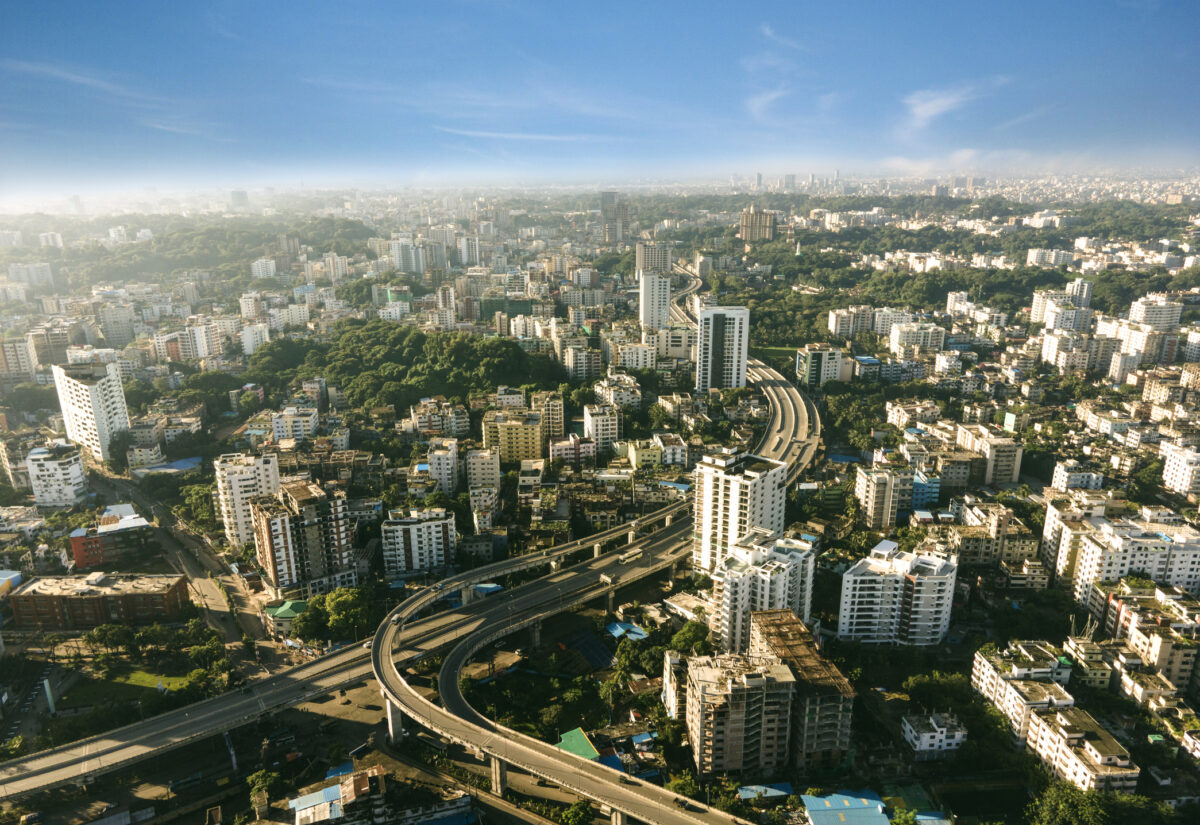
Resilient Urban and Territorial Development Project in Bangladesh
Adaptation Need
Rapid urbanization has been a significant driver for Bangladesh’s transition to a middle-income country, with urban areas contributing 75% of national GDP. However, climate change is intensifying infrastructure and service deficits, particularly in secondary cities with limited institutional capacity. Urban climate risks often originate beyond city boundaries, such as upstream flooding or cross-jurisdictional drainage issues, and climate impacts affecting urban areas may extend to surrounding areas. Thus, ensuring urban climate resilience requires coordinated, catchment-scale investments and stronger local capacity to plan, implement, and sustain climate resilient urban infrastructures and services.
GCA’s Added Value
GCA is pioneering a sub-catchment-focused approach to urban resilience by co-developing a standardized and replicable methodology to identify and enable cross-boundary urban climate resilience investments in close collaboration with key project partners. The methodology will be tested in three cities, through a hands-on learning approach that engages project partners in generating actionable, cross-boundary adaptation solutions. The capacity building of national and municipal officials will be complemented through the Urban Climate Resilience Masterclass, the Handbook on Climate Risk-Informed Master Planning, and the Nature-based Solutions Compendium, all of which are tailored to the Bangladeshi context.

Project goals
Mainstreaming Adaptation and Resilience
The standardized methodology and guidelines will inform Climate Resilience Action Plans, Pourashava Development Plans, and Cluster Development Plans of cities under RUTDP. GCA is strengthening Bangladesh’s national and municipal capacities for climate resilient urban development and infrastructure delivery through harmonized technical assistance to multiple IFI-funded projects (i.e., ADB, AFD, AIIB, KfW). GCA’s locally tailored knowledge products, tools, and training modules are reaching 152 of Bangladesh’s 329 pourashavas. GCA is supporting LGED to institutionalize capacity building on urban climate resilience a national training institution to ensure a scalable, long-term impact beyond the current project cycle.
Expected Outcomes
- Enhanced climate resilience at sub-catchment level for 3 pourashavas in Bangladesh. This will be achieved by identifying key climate risks for 3 pourashavas that extend to the sub-catchment level, encompassing their surrounding union parishads, prioritizing cross-boundary climate adaptation measures, and providing basic design guidelines, which will inform the detailed feasibility studies conducted by RUTDP.
- Improved climate resilience informed investment planning for LGED and pourashavas, through the co-development of the standardized methodology and guidelines that identify and enable cross-boundary climate resilient urban infrastructures and services.
- Strengthened institutional capacities of LGED and municipalities to plan, deliver and manage resilient urban services through hands-on learning during the development of the standardized methodology and guidelines, as well as the delivery of training modules, materials for training of trainers, and knowledge products.
Timeline
GCA Support Status
Technical Assistance Preparation
GCA Support Implementation
June, 2024
GCA Support Completion
Monitoring
Finance
Project Investment Value
Total Investment Value
IFI Investment Value
$400.00M
Other Investment Value
$160.00M
IFI partners


Contacts
General media inquiries
info@gca.orgRequest for information
waterandurban@gca.org