
Climate data for risk assessments
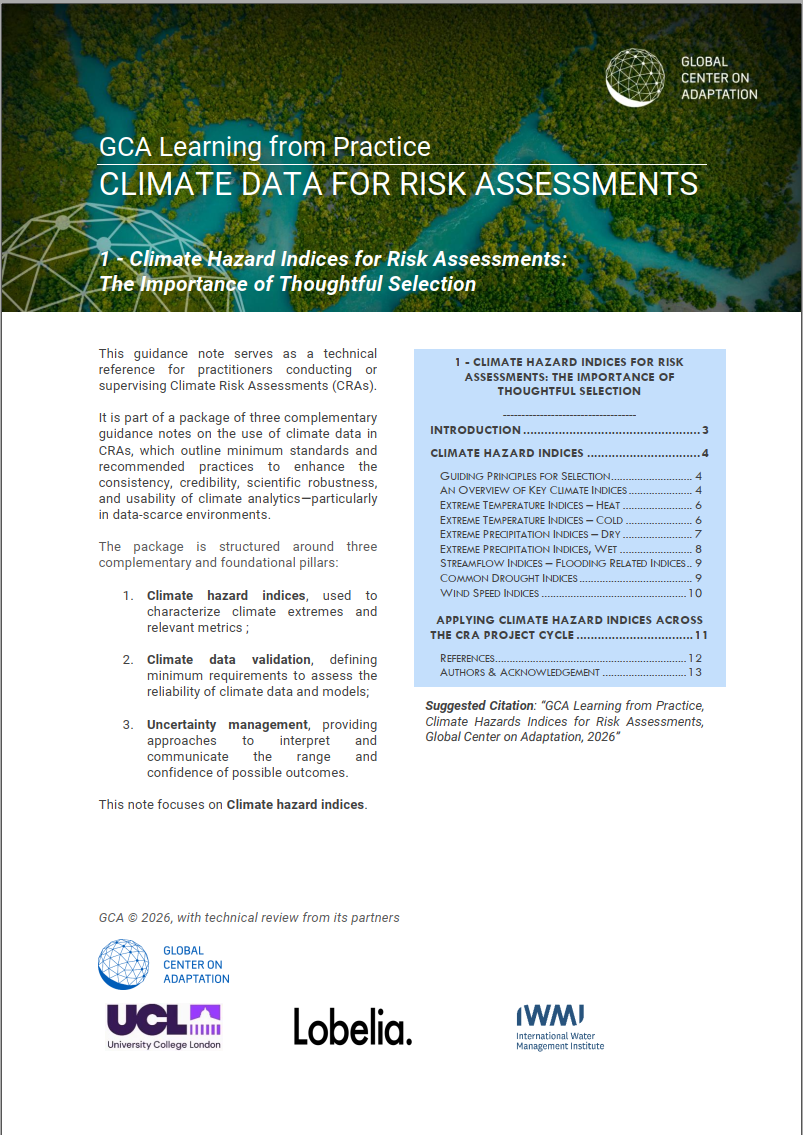
A three-part Learning from Practice guidance series
Climate risk assessments (CRAs) are only as strong as the data behind them. Yet practitioners and project sponsors often face the same questions: Which indices should we use? Can we trust the data? And how confident can we be in the results? This is especially true in data-scarce environments, where observations are limited and choices are hard to defend.
The GCA Learning from Practice series answers these questions in three complementary technical notes. Together they set out minimum standards and recommended practices to make climate analytics more consistent, credible, scientifically robust and usable for decision-making. Developed by GCA with technical review from University College London (UCL), the International Water Management Institute (IWMI) and Lobelia Earth, the notes are written for practitioners conducting CRAs and for those who commission and supervise them.
Three notes, one workflow
The notes follow the logic of a CRA, from choosing what to measure, to checking the data, to communicating what remains unknown.
1. Climate Hazard Indices: The Importance of Thoughtful Selection
What should we measure?
A structured reference of commonly used indices for heat, cold, drought, extreme rainfall, flooding and wind, aligned with international standards (ETCCDI and WMO). It offers guiding principles to match indices to project objectives and local context, and clear definitions that make results comparable across studies.
2. Climate Data Validation
Can we trust the data?
Minimum validation requirements by hazard type (temperature, precipitation, flooding and wind), scaled to the stakes of the assessment, from broad risk screening to engineering design. It includes a worked example comparing satellite and reanalysis products against in-situ observations, showing how to spot unreliable datasets before they shape decisions.
3. Uncertainty Management
How confident can we be, and how do we say so?
An approach to anticipating, quantifying and communicating uncertainty arising from data, models and future scenarios. It sets out minimum treatment by sector and level of stakes, and defines expectations for ensemble approaches and for the uncertainty statement in final reports.
Built for the whole project cycle
Each note closes with practical recommendations for project sponsors at four key stages: Terms of Reference/RFP, proposal review, inception report and final output review. Used together, they can serve as a ready-made reference for specifying requirements, assessing bids and holding consultants to a consistent standard of quality.
Who is this series for?
Practitioners and consultants designing and delivering CRAs
Project sponsors, development banks and public agencies drafting Terms of Reference and reviewing deliverables
Infrastructure, water, urban and food security specialists who rely on climate analytics to inform investment and planning decisions
Suggested citation: “GCA Learning from Practice, Climate Data for Risk Assessments, Global Center on Adaptation, 2026”
GCA reports may be republished in accordance with the Creative Commons Attribution-NonCommercial-
NoDerivatives 4.0 International Public License, and in accordance with our Terms of Use.